
Medicine Is Changing
From controlling disease to understanding regulation in living systems

Modern medicine has learned to study the body with extraordinary precision.
Yet an unexpected paradox is emerging: the more precisely we understand the parts, the less clearly we understand how the organism maintains itself alive as a whole.
Biology suggests that life is not organized through control, but through distributed regulation across complex networks.
This publication explores what medicine might look like as that realization slowly enters the clinic.
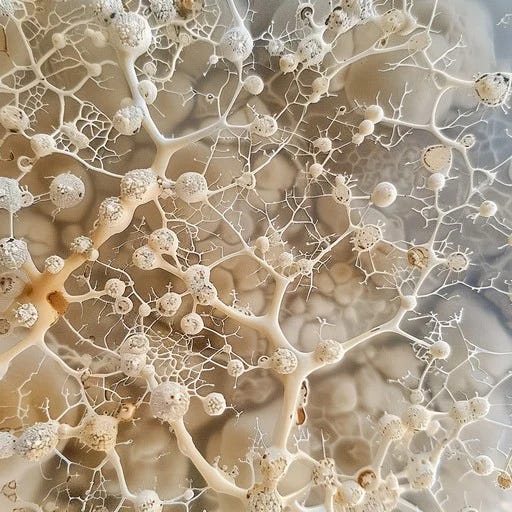
After several months away from publishing, I have been working on a manuscript that revolves around a question that has gradually become unavoidable to me:
What if medicine is undergoing a conceptual transition?
For centuries modern medicine has been built on a reductionist approach. The body has been studied by dividing it into parts — organs, tissues, cells, and molecules — each examined with increasing precision. This method has produced extraordinary advances.
But a paradox remains.
Understanding the parts does not fully explain how the organism maintains itself alive.
Over the last decades biology has begun to approach this problem from a different perspective. Fields such as systems biology and psychoneuroimmunology are revealing that living organisms function not as collections of isolated components but as networks of interacting regulatory systems.
The immune system communicates with the nervous system.
The microbiome influences metabolism and mood.
Hormones regulate one another through feedback loops.
Cells coordinate their behavior through continuous signaling.
For most of modern medical history we assumed that biological order requires control — that somewhere in the organism there must be a conductor directing the orchestra of life.
Yet as biology looks more closely at living systems, something surprising appears: there is no conductor.
Order emerges from countless interactions occurring simultaneously across cells, tissues, microbes, hormones, and neural signals.
__________________________________________________________________________
Life maintains itself not through centralized control, but through distributed regulation.
___________________________________________________________________________
This view of life as a self-organizing system is not entirely new. In the late twentieth century, biologists such as Humberto Maturana and Francisco Varela proposed that living organisms should be understood as autopoietic systems—networks capable of continuously regenerating and regulating themselves. Around the same time, the work of Ilya Prigogine in non-equilibrium thermodynamics showed how order can arise spontaneously in complex systems far from equilibrium.
Understanding this shift may transform how we think about health, disease, and even what it means to be alive.
What would medicine look like if we studied regulation as carefully as we study pathology?
What emerges is not a machine governed from a central command, but a living network capable of maintaining coherence through regulation.
This perspective is slowly transforming how we understand disease. Many conditions that once appeared as isolated malfunctions increasingly look like disturbances within regulatory networks.
Interestingly, long before modern instruments existed, several traditional medical systems attempted to describe patterns of regulation and adaptation in the human organism. Today, as biology begins to explore complexity more deeply, it is striking to see how different ways of observing life sometimes converge.
When I first began writing here, this publication was titled Medical Astrology. At the time I was exploring symbolic systems that attempt to describe patterns in human experience.
Over time my focus has widened.
What increasingly interests me is how multiple fields — systems biology, psychoneuroimmunology, and various historical medical traditions — may be observing different facets of the same phenomenon: the regulatory nature of living systems.
For this reason, this publication will gradually evolve into a space dedicated to what I call Medicine in Transition.
In the coming essays I will explore how medicine may be moving from a paradigm centered on controlling disease toward one concerned with understanding regulation within complex living systems.
Medicine is changing.
And learning to think in systems may prove to be one of the most important intellectual transitions of our time.
As biology begins to understand regulation within complex systems, a different definition of health slowly becomes visible.
__________________________________________________________________________
Health is the capacity of a living system to maintain coherence through regulation.
Health as regulatory coherence.
___________________________________________________________________________
In the essays that follow, I will explore how this perspective is emerging across biology, medicine, and several older traditions that attempted to describe the same patterns long before modern instruments existed.
If these questions interest you, you are welcome to follow the inquiry.
It's definitely time for a change
Western medicine specifically only targets a symptom tied to one system. In doing so it complicates the other systems that are tied to it. It also completely denies the mind/body connection that is critical to good health. I am grateful for the change so that individuals can receive better, more comprehensive care that is long overdue. Thank you for sharing 🙏
What if societies are also complex systems and we could shift from control to regulation to maintain coherence…that striked me when I red this interesting new development 😍